PS1 BIOS Download Best PS1 Emulator, Games Setup Guide
If you are still using PlayStation 1 for its classic games and you are looking for its BIOS file, you have reached the correct website because we will provide you with a full pack of firmware you can use to run the games in emulators like DuckStation, RetroArch, and ePSXe. with better compatibility than the real console. Choosing the correct firmware file is a bit confusing because there are a lot of versions of these files for different regions.
| Detail | Information |
| BIOS Type | PlayStation 1 System BIOS |
| File Format | BIOS Dump (Commonly BIN) |
| Downloads | 500K+ |
| Console Generation | Fifth Generation |
| BIOS Function | System Initialization and Game Compatibility |
| Supporting OS | Windows, Linux, Android, macOS and iOS |
| Compatible Emulators | ePSXe, DuckStation, RetroArch and Mednafen |
| Last update | 3- Days ago |
In this guide, I will guide you through the PS1 BIOS in all regions, including the USA, Europe, Japan, and Asia, and how the PS1 is different from the PS2 BIOS. You will learn why these files are important and how you can play the PS1 classic games on windows, iOS and Android, and or eligible devices you have. We will also discuss some common issues during configuration and their best possible solutions.
SCPH7003.BIN – Worldwide
Worldwide BIOS supports PlayStation games across all regions around the world.
SCPH5500.BIN – Japan
Japanese BIOS supports PlayStation games in Japan and other Asian regions too.
SCPH7502.BIN – PAL
European BIOS supports PlayStation games across Europe, the UK, and Australia.
SCPH1001.BIN – USA
North American BIOS supports PlayStation games from the USA and Canada region.
What are the PS1 BIOS?
PS1 BIOS files are the firmware files that help the emulator to act like the original console and run the games with better compatibility. It helps to initialize the hardware of your console and also provides the software which is essential to launch the game. These are completely different files: the Input/Output System, while the game file contains the game itself. The best way to get this firmware is to dump it from your own console. And if you don’t know how to dump these files, there is nothing to worry about because the whole process is provided further in this blog. You will also learn how to Install PS2 BIOS step by step.
Best emulator for PlayStation 1
Playing PlayStation games on other devices like Windows, iOS, or Android requires the good emulator. Now we will discuss some of the best emulators for PS1; you can use them to play the classic games on your desired device.
DuckStation:
If you want to play classic ps1 games on modern devices includes Windows PCs, Linux computers, macOS systems, and Android devices. The best emulator option is DuckStation because it provides the best emulation and a large variety of game compatibility. It provides enhanced graphics for the old classic games. DuckStation supports compatible controllers, including many USB and Bluetooth gamepads.
RetroArch:
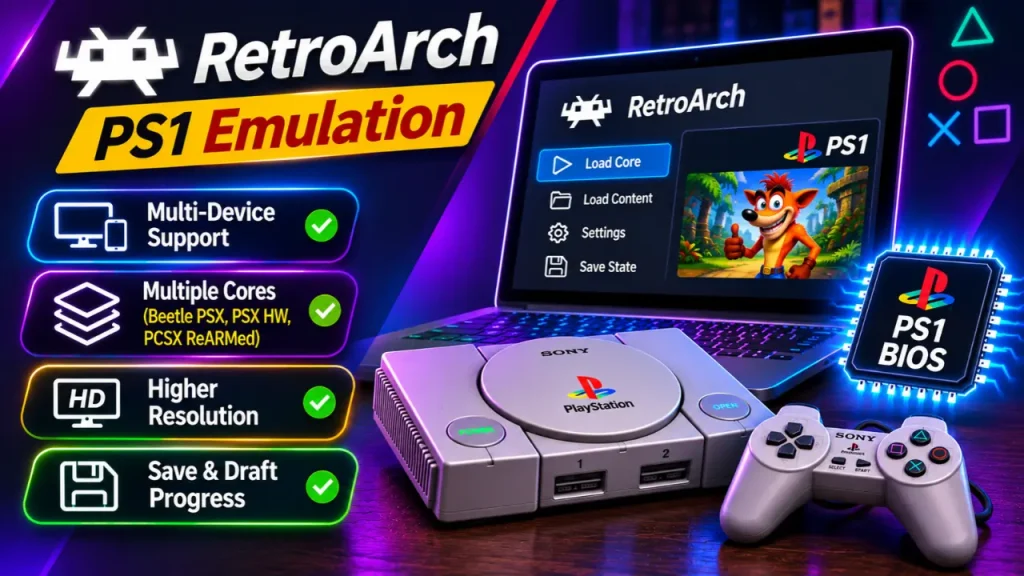
RetroArch is another good emulator that provides support for multiple devices. It allows the user to play games through a unified interface. RetroArch also supports several emulator cores, including Beetle PSX, Beetle PSX HW, and PCSX ReARMed. It also enhances the game resolution with better gaming experience. It also provides save and draft option to save the progress of the game.
ePSXe:
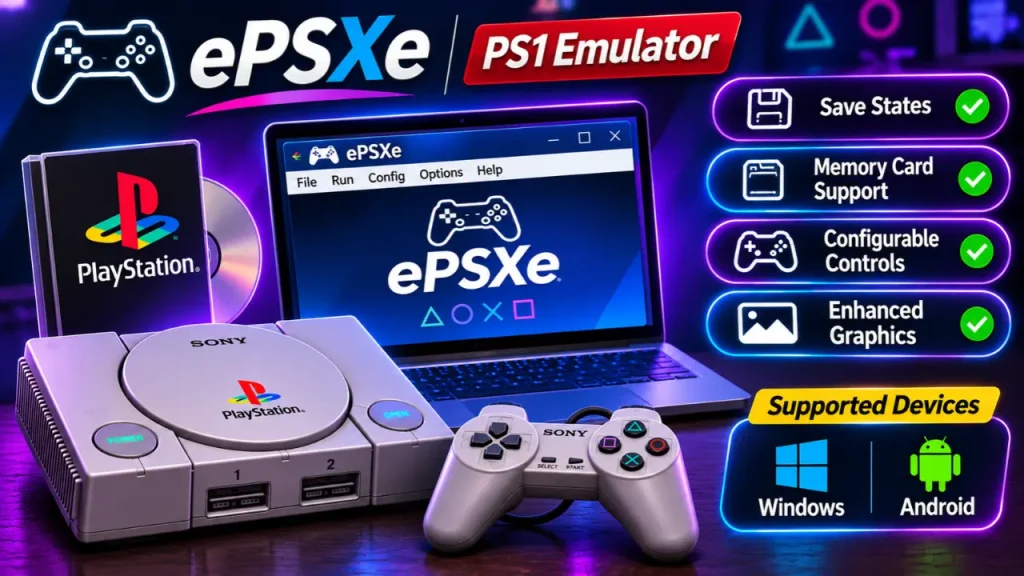
ePSXe is another emulator which is used for playing PS1 games on computers and Android devices. Moreover, it offers many features like save states, memory card support, configurable controls, and enhanced graphics. You can also set the controller according to your preferences. ePSXe has enabled users to play the console game without its hardware. It is compatible with iOS devices; you can only use it for Android and Windows devices.
Mednafen:
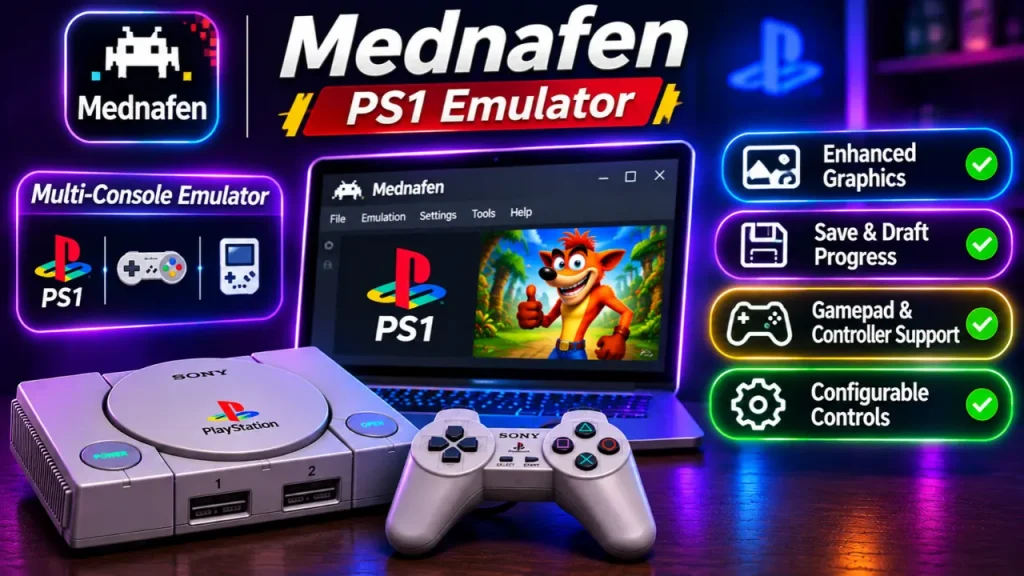
Mednafen is another amazing emulator that not only allows you to play the ps1 games but also enables you to play other console games. It is one of the best choices for PS1 games. It has enhanced graphics and many other features like save and draft options, which enable users to save game progress. It also supports the gamepad and controller, and you can set the controller according to your preference.
PS1 BIOS All Regions Download: Complete Guide
The original PlayStation was released in many regions around the world with different versions and models. The major regions include North America, Japan, and Europe. Asians mainly use the Japanese version to play games on the console. Each region also has its own game compatibility because it has different firmware. Choosing the version that matches your game region is a simple way to avoid unnecessary compatibility problems.
BIOS filename | Region | Region code | Typical use |
|---|---|---|---|
scph1001.bin | USA | NTSC-U/C | Older North American BIOS revision |
scph5501.bin | USA | NTSC-U/C | Common North American BIOS |
scph5500.bin | Japan | NTSC-J | Japanese-region games |
scph5502.bin | Europe | PAL | European-region games |
scph7001.bin | USA | NTSC-U/C | Another North American revision |
scph7002.bin | Europe | PAL | Another European revision |
scph7003.bin | Asian market | NTSC-J-related | Associated with certain Asian-market models |
scph7502.bin | Europe | PAL | Another European BIOS revision |
USA (NTSC-U/C):
NTSC-U is the North American model of the console in which only North American console firmware is usable. It mainly includes these two models: scph1001.bin, scph5501.bin. The SCPH-1001 firmware is associated with earlier versions of consoles in the USA and Canada region. And the other scph5501.bin is used in the modern version or later released version of PS1 NTSC-U. Many emulators recognize one or both versions, but the compatibility of the games depends on the specific emulator and core.
Japan (NTSC-J):
NTSC-J is the version associated with the consoles of Japan and the Asian region. It has its own NTSC-J software. The common firmware file in the console of the Japan region is scph5500.bin. The consoles of this region have different game compatibility than North American or other European consoles due to regional licensing checks and video-system differences. This version is useful when playing original Japanese releases or Japan-exclusive titles.
Europe (PAL):
The video system in the consoles of the European region uses PAL software. The common file names for this region include scph5502.bin,scph7002.bin,scph7502.bin. Scph5502.bin is mainly associated with older versions of the console, while scph7002.bin and scph7502.bin are the same, but they are files for the revised version of the console. Almost all consoles in the European region have PAL firmware for better compatibility with European-region licensed games. If you primarily play European PS1 games, use PAL firmware.
Asian PS1:
The asian region console mainly uses the scph7003.bin file, but this is not the universal bios for PS1 in asia and it is not compatible for all games. This is because Asian consoles don’t have any regional firmware files like PAL and NTSC. That is why some use the Japanese firmware, and some emulators and games are compatible on scph7003.bin file. The consoles in the Asian market are associated with the SCPH-xxx3 model family.
What Is the Difference Between NTSC and PAL?
How to dump the BIOS PS1 from the Console?
Dumping the files from your own console is the best and safest way to get the firmware files of the model because Playstation1 BIOS is copyrighted software owned by Sony. So downloading it from different websites may be risky. If you don’t know how to dump these files from the PS, then follow the steps given below:
Step 1: Identify Your PS1 Model:
Firstly, identify the model of your console because, as you know, different models and region consoles have different firmware bios such as SCPH-5501 for North America and SCPH-5502 for Europe.
Step 2: Choose a Compatible Extraction Method:
Unlike PS2, which has the FreeMcBoot or FreeDVDBoot extraction method, PS1 doesn’t have this. You have an appropriate extraction method; the common options are Hardware-based extraction, Console-based software method, and Chip-reading method.
Step 3: Prepare the Required Equipment:
Depending on your extraction method, you need compatible homebrew software or may be the storage device, or additional hardware. Now follow the instructions according to the model of your console.
Step 4: Run the BIOS Extraction Utility:
Now use the trusted software that is designed for extraction of firmware for PS1. After extraction, save the files to your console or to the storage device.
Step 5: Transfer and Verify the BIOS File:
Now transfer the field from your storage device to your computer and then check whether the files are completely extracted, you can check the version on checksum; if it matches, then the files are complete.
Step 6: Configure Your Emulator:
Now put the files in the BIOS directory of the emulator you are using, mainly DuckStation or a compatible RetroArch core. Then your emulator will scan and recognize the files for the configuration of games.
How to Add BIOS to DuckStation ( Windows PC )
Playing games on your Windows device through DuckStation is quite easy. You have to follow the steps accurately, and you have to provide the correct BIOS directory in DuckStation. The method is explained below:
Step 1: Get a PS1 BIOS File
Firstly, dump the files from your console; the common file names include scph5500.bin — Japan, scph5501.bin — USA, and scph5502.bin — Europe. Make sure to do this step accurately because it is the most important step.
Step 2: Open DuckStation’s BIOS Folder
To open the files folder in DuckStation, follow this path: Tools → Open Data Directory. This is the place where DuckStation saves or stores the firmware files. The location for this folder will look like this:
%LOCALAPPDATA%\DuckStation\bios
Step 3: Copy the File:
- Locate your PS1 BIOS file on your computer and copy the file.
- Then paste them directly in the bios folder of DuckStation.
- Make sure to put the file in the correct directory; don’t put it into any other subfolder.
The folder will look like this:
DuckStation/bios/scph5500.bin or any other filename according to the region.
Step 4: Configure the BIOS in DuckStation
Now, for the configuration of files in DuckStation, follow this:
- Open the emulator and go to Settings → BIOS.
- Check the directory of the BIOS.
- If it is correct, then click refresh to rescan the folder.
- Select the appropriate BIOS for the game region.
Step 5: Test the BIOS
To test the files, launch the game. If the game initiates correctly without any error, then your firmware is embedded correctly. If you get the “No BIOS image found” error, then you haven’t embedded the files correctly; retry the process.
PS1 BIOS for RetroArch
RetroArch is also a multi-device emulator; now we will see how to add the bios in the RetroArch emulator. To improve the compatibility of the games, you have to add the correct and appropriate firmware files. Now follow the steps below:
Step 1: Get a BIOS File
Firstly, you have to get the appropriate and correct files for your region. Remember that files for your own region will have better compatibility, so get them for your own console, or you can download them from our website.
Step 2: Find RetroArch’s System Folder
Open the emulator and go to Settings → Directory → System/BIOS. This is the place where the files are stored.
Step 3: Copy the BIOS File
Open the directory and copy the files, and then store them in your pc or storage device. For Windows, the folder path will look like this:
RetroArch/System/scph5500.bin or scph5501.bin or scph5502.bin.
Step 4: Install a PS1 Core
- Open RetroArch.
- Then go to Online Updater → Core Downloader.
- Then you have to choose one core from these: Beetle PSX, Beetle PSX HW, PCSX ReARMed.
Step 5: Load a PS1 Game
- Now select the load content.
- Then look for your ps1 game files.
- Select the game and start it.
Step 6: Verify the BIOS
Open the game’s Quick Menu → Core Information hee you can check the bios status. To know whether the files are working or not.
Is downloading the BIOS PS1 from a third party legal?
PS 1 BIOS is copyrighted software owned by Sony. Many third-party websites offer these files, which is completely illegal. The only legal way to download these files is to extract them from a Sony PS1. We provide these BIOS files for educational purposes and for people who don’t know how to extract them from their own console. We provide these files for convenience. But the best way is to extract the files from your own console. So there will be no copyright or any illegal activity.
Final Thoughts
In the end i hope you understand how the files work and how to add them in your respectable device. Third-party websites may provide incorrect or malicious files, but our website is completely safe and contains no malicious content. But the best way to get the firmware files is to dump them directly from your own PlayStation. We provide the files for every region, including NTSC-C, NTSC-J, NTSC-U, or PAL. Moreover, always put the correct regional files in the emulator for better compatibility. Thanks for visiting our website. We hope we have met all your requirements.